
Why Agency Founders Hate the Words “Thought Leadership” (And What to Do Instead)
Quick Answer
Thought leadership content for agency founders means posting expert insights on LinkedIn that build trust with buyers before the first call. It is not about going viral or gaining followers. It is about showing up consistently with a real point of view so the right clients already respect you when they reach out.
The Phrase That Kills the Idea Before It Starts
Say the words “thought leadership” to a marketing agency founder and watch their face. There is a flicker of something. Not interest. More like recognition mixed with mild contempt. They have heard it too many times, attached to too many things that did not work.
And look, I get it. The phrase has been used to justify AI-generated posts about hustle culture, carousels with stock photos, and “hot takes” that are just reworded versions of something Gary Vee said in 2017. If you have been in this industry long enough, the term has essentially become a flag planted on low-effort content.
Here is the specific irony. Agency founders are professional marketers. They know exactly what a healthy inbound pipeline should look like. They have built those pipelines for clients. They have written the strategy decks. They have done the LinkedIn audits. And yet their own marketing is either non-existent or deeply inconsistent. They know they should be more visible. They just hate how visible people tend to do it.
“I know, I know.” That is what most founders think when someone tells them to build their personal brand. They already know. Knowing is not the problem.
So when someone tells them to “create thought leadership content,” what they hear is: become one of those people. The kind who post about their morning routine and call it strategy. The kind who get 3,000 likes on a post that says nothing. No thanks.
But here is the thing. The underlying idea is not wrong. The label is just doing real damage to it.
What “Thought Leadership” Actually Means When It Works
Strip the phrase away entirely. What is actually being described?
Consistent expert content that builds trust with buyers before they ever reach out to you. That is it. That is all it is. You share what you know. You do it in a way that sounds like you. You do it regularly enough that the right people start to recognize your thinking. And when those people eventually have a problem you can solve, they already know where to find you.
This is not a social media strategy. It is a business development strategy that happens to run through LinkedIn.
58% of B2B decision-makers spend an hour or more per week engaging with this type of expert content on LinkedIn. By the time they reach out, they already know how you think.
Edelman B2B Thought Leadership Impact Report, 2025
Agency deals do not close fast. The average buying cycle for a founder-led agency runs seven to twelve weeks. The client you close in March started paying attention to your content in January. They watched a few posts. Nodded along. Shared one with their team. And when their current agency failed them, your name was already in their head.
That is what this content actually does. It does not generate leads in the traditional sense. It shortens the trust gap so that by the time someone does reach out, there is no pitch required. The conversation starts from a different place.
Why Agency Founders Are the Worst at This (And the Best Positioned to Fix It)
Here is the uncomfortable stat. According to SparkToro’s State of Digital Agencies report, only 13 to 14% of agency founders have a healthy sales pipeline. That means 86% are in some version of the problem. Feast or famine. A good month followed by a quiet one. Pipeline that lives or dies on whether a referral comes in.
86% of agency founders do not have a healthy sales pipeline. 66% rely on referrals as their primary source of new business. They know it is fragile. Most have not found anything reliable enough to replace it.
SparkToro State of Digital Agencies, 2024
This is not because they lack expertise. Most of the agency founders I talk to are genuinely sharp. They have earned real opinions through years of client work. They have seen what works and what does not. They have a perspective that would actually be worth reading.
The problem is they are also running a company, managing clients, doing delivery work, and handling finance. By the time they sit down to write something for LinkedIn, it is 9pm and they have nothing left. They type three sentences. Delete them. Close the laptop. The post does not go out.
That cycle repeats until posting just stops. And the pipeline stays broken.
The irony is that agency founders are better positioned than almost anyone to do this well. They have years of specific, applicable expertise. They understand their clients’ problems deeply. They have real opinions. They are not starting from zero. They are starting from a lot, and not translating any of it.
The Real Problem Is Not Posting. It Is Positioning.
Content paralysis is a symptom. It is not the root problem.
When founders say they do not know what to write, they almost always mean one of three things. They do not have a clear sense of who they are writing for. They do not have a defined point of view about their work. Or they have both, but they have no frame for how to translate that into a LinkedIn post without sounding like a vendor.
Generic posting is what happens when those pieces are missing. You end up with “5 tips for better client communication” or a repost of an industry article with two sentences of commentary. Safe. Forgettable. Not wrong, exactly. Just not doing anything for anyone.
The people who post that kind of content do not get clients from LinkedIn. They get likes from colleagues. And then they tell people LinkedIn does not work.
LinkedIn works. Generic content does not.
A positioned founder sounds different. They write about a specific type of client. They name problems that client is living but not saying out loud. They take a stance on something people in their space are doing wrong. They share results with enough specificity that a reader thinks: this person actually understands my situation.
That is the difference. Not format. Not frequency. Positioning.
Once the positioning is clear, the content becomes much easier to write. You are not trying to appeal to everyone. You are trying to speak directly to one kind of person and say something true.
What to Call It Instead (And How to Actually Do It)
Drop the phrase entirely. Here is a better frame: expert content that brings clients to you.
It is less poetic. But it keeps the focus where it belongs. Not on being seen as an authority figure. On generating a pipeline that does not depend on the same five referrals.
For agency founders, three content types tend to do real work on LinkedIn.
The Specific Observation
You name something your ideal client is experiencing right now, but probably has not said out loud. Not a trend. Not a prediction. A specific, concrete thing you have noticed in your work.
Most agency founders I talk to are not worried about finding more clients.
They are worried about finding the right ones.
The ones who show up to the first call already knowing what they need. Who do not ask for a discount on the second email. Who say yes or no without a six-week approval chain.
That kind of client does not come from cold outreach.
They come from watching you for a few months and deciding they already trust you.
Notice what that post does. It does not sell anything. It does not explain LinkedIn strategy. It names a specific problem in specific language, and it makes the reader feel understood. That is the job.
The Contrarian Take
You push back on advice your ideal client has already tried and been burned by. This is not contrarianism for its own sake. It is calling out something that is actually wrong.
“Niche down” is the advice everyone gives agency founders.
And it is not bad advice. It is just incomplete.
The founders I see winning are not niche by industry. They are niche by problem. They solve one specific type of client problem, and they do it for anyone who has that problem.
That distinction matters when you are writing LinkedIn content.
“I help e-commerce brands” is a vertical niche. “I help founders who are tired of having no idea where their next client is coming from” is a problem niche.
The second one starts more conversations.
The Quiet Case Study
You describe a client situation and outcome without naming the client. The power is in the specificity of the problem, not the identity of the company.
A client came to me eight months ago.
Four-person digital marketing agency. Paid media focus. Everything they had tried on LinkedIn had either felt fake or produced nothing.
We spent three sessions just figuring out what they actually believed about their work. Not their services. Their beliefs.
Turns out they had a strong opinion about something most agencies were doing wrong in paid media strategy.
We made that opinion the spine of their content for 90 days.
Eleven inbound DMs in month three. Six discovery calls. Three new clients.
None of them asked what the retainer cost before they reached out.
No client name. No NDA issues. The result is specific enough to be credible without giving anything away.
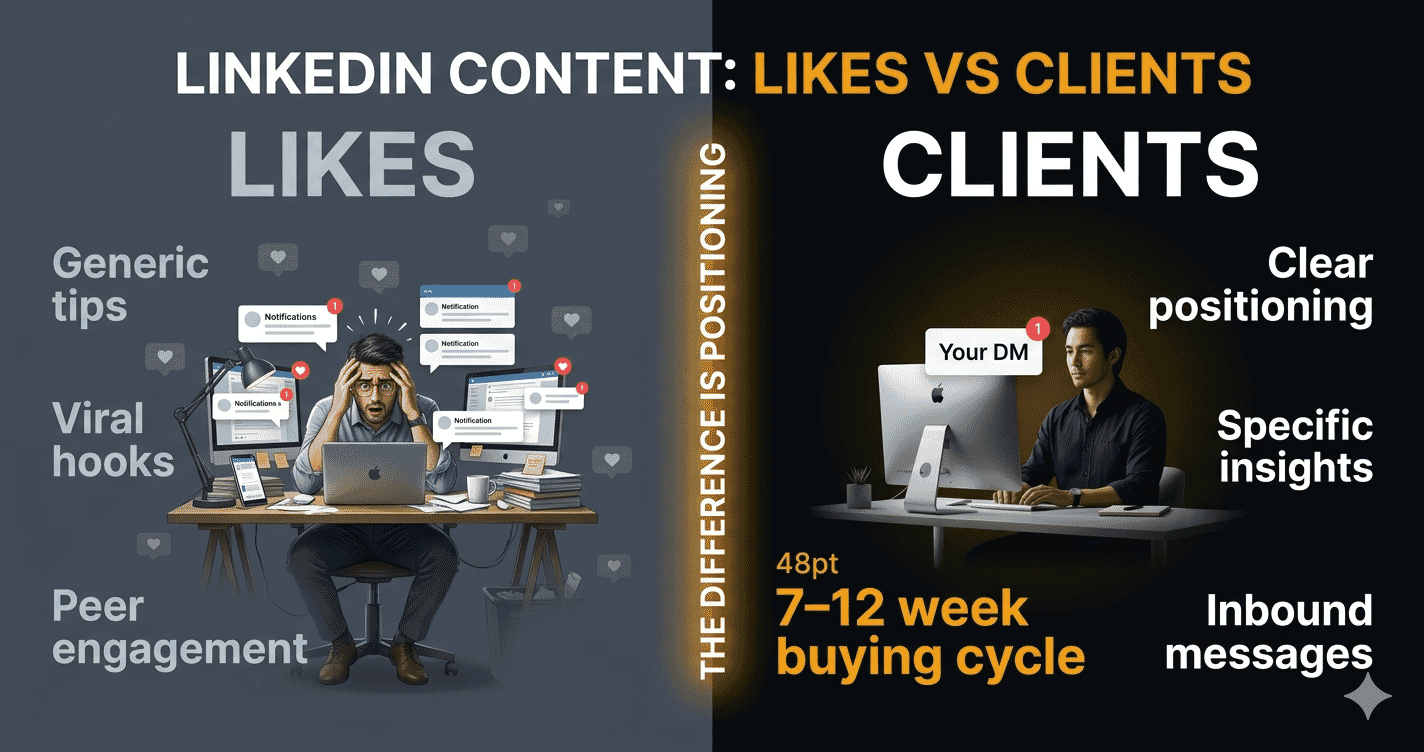
The Difference Between Content That Gets Likes and Content That Gets Clients
This is where most founders go wrong on LinkedIn, and it is worth being direct about.
Likes come from peers. Clients come from buyers. Those are not the same audience, and content that performs well with one often does nothing with the other.
| Content That Gets Likes | Content That Gets Clients |
|---|---|
| Broad advice anyone can use | Specific observations for a specific type of buyer |
| Viral-friendly format and hooks | Consistent point of view over time |
| Follower growth as the metric | DMs from the right people as the metric |
| Engagement from other marketers | Quiet attention from buyers watching your feed |
| One post that reaches many | Many posts that reach one type of person, repeatedly |
Agency founders have a seven to twelve week sales cycle. Buyers do not show up after one post. They show up after watching you for two or three months and deciding you understand their situation.
That means reach is not the metric that matters. The right metric is this: are the people engaging with your content the kind of people you want to work with? Are the DMs coming from potential clients or from other content creators?
If you have been posting for a while and only peers are responding, that is a positioning signal, not a platform problem. The content is probably too broad, too safe, or too focused on impressing colleagues rather than speaking directly to buyers.
The fix is not to post more. It is to post differently. Narrower. With a clearer point of view. In language that your ideal client actually uses about their own situation.
When that shift happens, the comments get quieter and the DMs get better. That is the signal you want.
Frequently Asked Questions
For agency founders, it means posting expert insights on LinkedIn that build trust with potential clients before the first call. It is not about going viral. It is about showing up consistently with a clear point of view so the right buyers already respect you when they reach out.
Why do agency founders dislike the term thought leadership?
They have watched the phrase get used to describe AI-generated posts, recycled tips, and content that chases likes instead of clients. It sounds like performance, not strategy. Most founders are also introverts who dislike self-promotion, so the term makes an already uncomfortable task feel worse.
What should agency founders actually post on LinkedIn?
Three content types work best. First, specific observations that name something your ideal clients are experiencing but not saying out loud. Second, contrarian takes that challenge advice your audience has been burned by. Third, quiet case studies that describe a client problem and outcome without naming the client.
How does LinkedIn content help agency founders get inbound leads?
Consistent expert content builds familiarity over time. By the time a potential client reaches out, they already know how you think, what you believe, and roughly what you charge. The conversation starts from a position of respect rather than a cold pitch. This is how LinkedIn replaces referral dependency over 90 to 180 days.
How long does it take for LinkedIn content to generate leads for agency founders?
Most agency founders see meaningful inbound activity after 90 to 180 days of consistent posting. The timeline depends on posting frequency, the clarity of the point of view, and how well the content speaks to a specific type of client. Content that gets likes from peers is not the same as content that gets DMs from buyers.
Do agency founders need a LinkedIn ghostwriter?
Not every founder does. But many have tried writing their own content, found it hard to stay consistent, or posted things that sounded nothing like them. A LinkedIn ghostwriter who specializes in agency founders can extract your real expertise and turn it into content that sounds like you on your best day, without you spending hours staring at a blank screen.
What is the difference between thought leadership content and regular LinkedIn posts?
Regular LinkedIn posts share general advice or updates. Expert content, done well, shares a specific point of view that could only come from someone with your exact experience. It makes your ideal client feel understood. It gives them a reason to follow you, trust you, and eventually reach out.
If any of this sounds familiar, let’s talk.
I work with agency founders to turn their real expertise into LinkedIn content that brings the right clients to them. No volume plays. No generic posts. Just a clear point of view, consistently written in your voice.